ECO4 open until 31 December 2026info@applyfreeboiler.uk
We would like to use analytics cookies (PostHog and Google Analytics) to understand how this site is used. They stay off unless you accept. You can change your choice at any time from the Cookie settings link at the bottom of every page.
You can still get a loft insulation grant in 2026, but not from the Great British Insulation Scheme, which closed on 31 March 2026. Free or part-funded loft insulation is available through ECO4 (to 31 December 2026) if you get certain benefits or a council referral, and through the Warm Homes: Local Grant in England. Funding is never guaranteed.
Step 1 of 5
ApplyFreeBoiler Team. Last reviewed 2 October 2026 against GOV.UK, Ofgem and Energy Saving Trust sources listed at the end of this page. ApplyFreeBoiler.uk is a private eligibility and application-support service, not the government, Ofgem, a council, an energy supplier or an installer.
Costs are Energy Saving Trust averages for a gas-heated home going from no insulation to 270mm. See the cost table.
Two schemes can still pay for loft insulation in Great Britain: ECO4 and, in England only, the Warm Homes: Local Grant. The Great British Insulation Scheme is closed. ECO4 is an obligation on energy suppliers rather than a government grant, so you apply through a supplier or installer, not through Ofgem.
| Scheme | Status on 2 October 2026 | Where | Loft insulation |
|---|---|---|---|
| Great British Insulation Scheme (GBIS) | Closed on 31 March 2026 | Great Britain | No longer taking applications |
| ECO4 | Closes 31 December 2026; suppliers may stop earlier | Great Britain | Yes, usually as part of a wider package of measures |
| Warm Homes: Local Grant | Councils deliver from 1 April 2025 to 31 March 2028 | England only | Yes, loft insulation is an eligible measure |
Sources: Ofgem GBIS page, Ofgem ECO page and the GOV.UK Warm Homes: Local Grant page.
GBIS covered insulation for homes rated EPC D to G in Council Tax bands A to D in England, or A to E in Scotland and Wales. It stopped taking applications on 31 March 2026. Our Great British Insulation Scheme guide explains how it worked. Households that would once have used it should look at ECO4 Flex or the Warm Homes: Local Grant instead.
ECO4 closes on 31 December 2026, and Citizens Advice warns that suppliers might stop taking applications sooner. Do not plan on ECO4 loft insulation being available in 2027.
ECO4 covers Great Britain, so Scottish and Welsh households can use it. The Warm Homes: Local Grant is for England only. Each nation also runs its own support:
Your household needs to meet an income or benefits test, and your home needs to be in the right EPC band. Age, on its own, does not qualify you for any of these routes.
| Route | Household test | Property test | Where to apply |
|---|---|---|---|
| ECO4, benefits route | Someone in the home receives a listed benefit (see above) | EPC D to G if owner-occupied; E to G if privately rented | An energy supplier or installer, or our eligibility check |
| ECO4 Flex (LA Flex) | Council referral: gross household income under £31,000, or a proxy, medical or bespoke route in the council’s Statement of Intent | EPC D to G if owner-occupied (E to G on the proxy route); E to G if privately rented | Your council, if it takes part in Flex, or our eligibility check |
| Warm Homes: Local Grant | Any one of: postcode in the most income-deprived 20% of England; a listed means-tested benefit or ECO Flex route 2; or gross income under £36,000 (or the after-housing-costs equivalent) | EPC D to G; owner-occupied or privately rented; England only | GOV.UK or your council |
ECO4 accepts a household if someone living there receives one of these benefits, per the Ofgem ECO4 Delivery Guidance:
Universal Credit
Pension Credit (Guarantee Credit and Savings Credit)
Income-related Employment and Support Allowance (ESA)
Income-based Jobseeker’s Allowance (JSA)
Income Support
Housing Benefit
Child Benefit, subject to income caps and household make-up
Benefits that are not on the list, such as the State Pension on its own, do not count. Proof of the benefit must be dated within the 12 months before the work is completed. ECO4 is also built around whole-home improvement: projects have to raise the home’s energy rating by a minimum amount, so a loft-only job may not qualify and loft insulation is often one part of a wider package. For owner occupied homes rated E to G, the loft and any cavity walls must be insulated before heating measures such as a new boiler can be funded, unless they are already insulated to standard.
Older households can read our guide to loft insulation grants for pensioners, which covers Pension Credit and council referrals in more detail. For the full scheme rules, see our ECO4 scheme guide.
ECO4 Flex lets a local authority refer private households that are low income, fuel poor or vulnerable to the cold. Route 1 is a gross annual household income under £31,000, counting all adults aged 18 or over living in the home. Other routes cover areas of deprivation, long-term health conditions made worse by a cold home, and bespoke council criteria.
Taking part is optional for councils: yours must have published a Statement of Intent on its website. Social housing is not eligible. Our LA Flex guide explains how to find your council’s statement.
The Warm Homes: Local Grant is paid for by government and delivered by councils. Loft insulation is on its list of eligible measures. You qualify if your home is rated EPC D to G and you meet any one of three tests:
Under the DESNZ policy guidance, owner-occupiers are not required or expected to contribute to the cost of upgrades. Delivery runs from 1 April 2025 to 31 March 2028, but it depends on your council taking part, so availability varies by area. Apply on GOV.UK or call the helpline on 0800 098 7950; your council should contact you, usually within 10 working days. Our Warm Homes: Local Grant versus ECO4 comparison sets out the differences.
Tenants in privately rented homes can qualify, and ECO4 work needs the landlord’s permission. In a privately rented home, an ECO4 package has to include solid wall insulation, first-time central heating, a district heating connection or renewable heating, with limited exceptions. A loft-only job is therefore generally not possible through ECO4.
Under the Warm Homes: Local Grant, tenants are not expected to contribute. A landlord can have one home fully funded, and is asked for a 50% contribution on each additional home. See our guide for private tenants and landlord permission.
Building regulations specify at least 270mm of mineral wool, according to Energy Saving Trust, and Which? gives the same target. An uninsulated roof loses about a quarter of a home’s heat, and loft insulation lasts about 40 years.
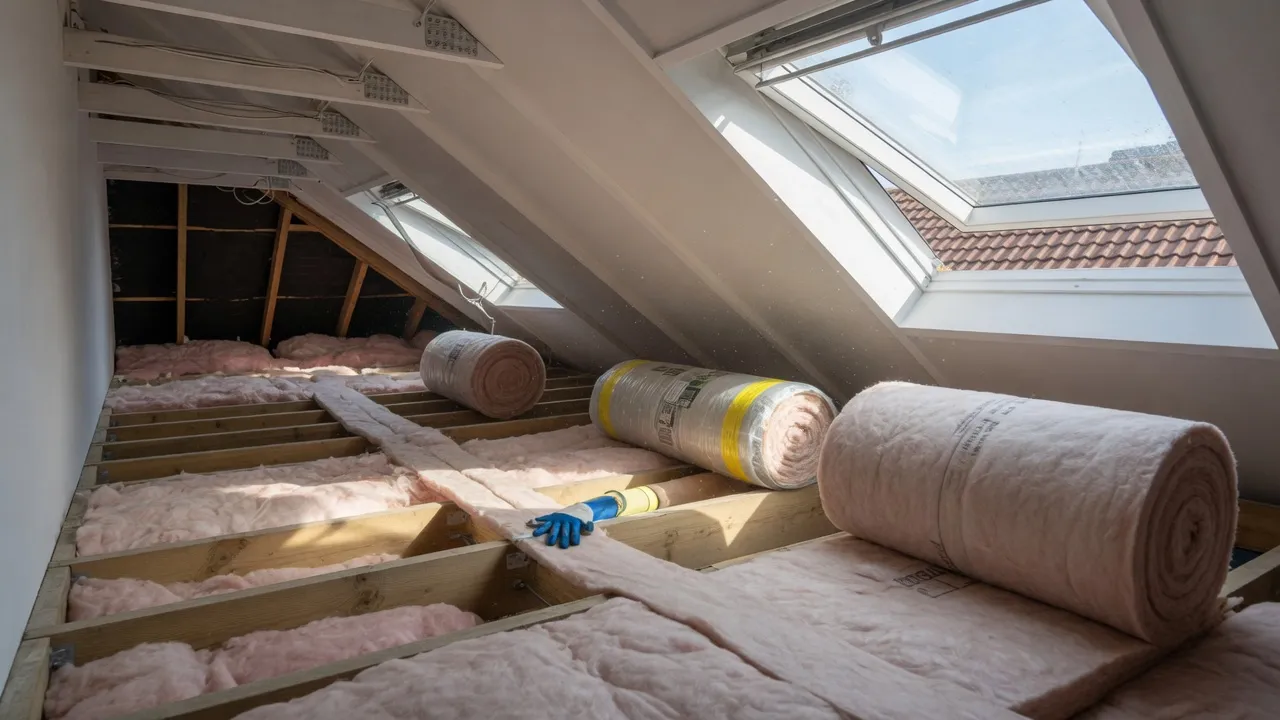
Mineral wool laid to at least 270mm, between and over the joists.
Eaves left clear so the roof space stays ventilated and condensation does not build up.
The loft hatch insulated and draught-proofed.
Cold water tank and pipes insulated, but no insulation laid underneath the tank.
Damp or condensation problems fixed before insulating.
A TrustMark-registered installer working to PAS 2030 and PAS 2035 if the work is funded by ECO4.
The ventilation, hatch, pipes and tank points come from the DECC loft insulation factsheet (2016). Energy Saving Trust adds that flat roofs, lived-in lofts and lofts with damp need a professional installer.
Be careful with spray foam. Citizens Advice says spray foam in roofs can reduce ventilation, hide problems such as leaks, be hard to remove and make it harder to get a mortgage. It advises independent surveyor advice before you agree to it. It also warns that a cold caller pushing insulation you did not ask for could be a scam.
For ECO4 work, the installer must be TrustMark registered and work to PAS 2030 and PAS 2035, you sign a declaration about the insulation already in your loft before work starts, and the measure must come with a 25-year guarantee. If your walls need insulating too, see our guides to cavity wall insulation grants and external wall insulation grants.
Energy Saving Trust puts the average professional cost at £650 to £1,200 for a gas-heated home going from no insulation to 270mm, depending on the property. The saving is £140 to £360 a year at July 2026 fuel prices.
| Property type | Typical professional cost | Saving per year | Simple payback* |
|---|---|---|---|
| Mid-terrace house | £650 | £140 | about 4.6 years |
| Semi-detached house | £750 | £190 | about 4.0 years |
| Detached bungalow | £1,200 | £350 | about 3.4 years |
| Detached house | £1,100 | £360 | about 3.1 years |
Source: Energy Saving Trust (page updated 8 May 2026; figures for a gas-heated home, unsubsidised, fuel prices July 2026). *Our arithmetic: cost divided by annual saving. Your own figures will differ.
Topping up existing insulation saves far less. Energy Saving Trust gives about £600 as the cost of going from 120mm to 270mm, for a saving of about £17 a year.
A funded job is not always free. Citizens Advice says a supplier may ask for a contribution, and the installer should tell you how much before you agree. Get that figure in writing.
Work out which route fits you, gather proof, then apply through the right channel. The steps are:
ApplyFreeBoiler.uk is run by Reliant Energy Solutions Ltd, an ECO4 installer. We check your eligibility for ECO4 and LA Flex, survey your home and fit the insulation ourselves. The check is free and carries no obligation. We cannot guarantee approval before the survey, because eligibility is decided under the scheme rules.
Check Your EligibilityECO4 closes on 31 December 2026. The Warm Homes Plan says the government will bring supplier obligations to a close, and that from 2027/28 it intends to combine the Warm Homes: Social Housing Fund and the Warm Homes: Local Grant into a single low-income scheme.
We could not confirm the eligibility rules or loft insulation coverage of that future scheme on 2 October 2026, so we do not describe them here. The Warm Homes: Local Grant is due to deliver until 31 March 2028. If you want ECO4 support, apply early.
Read the ECO4 deadline explainer and our Warm Homes Plan guide for the wider picture, or browse every insulation grant we cover, or try our insulation savings calculator.
Possibly. The Great British Insulation Scheme closed on 31 March 2026, so there is no general loft grant. You can still qualify through ECO4 (benefits or a council referral, closing 31 December 2026) or, in England, the Warm Homes: Local Grant (income, benefits or postcode based). Which route applies depends on your income, benefits, EPC rating and council.
No. The Great British Insulation Scheme closed on 31 March 2026, according to Ofgem. It was a separate scheme from ECO4. If an advert or caller still offers GBIS loft insulation, ask which scheme is actually paying for it and do not agree to anything until you have the answer in writing.
Possibly. ECO4 accepts Universal Credit, Pension Credit, income-related ESA, income-based JSA, Income Support and Housing Benefit, plus Child Benefit under income caps, and your home usually needs an EPC rating of D to G. Funding is not guaranteed and a supplier may ask for a contribution, so get the cost in writing before you agree.
Possibly. Through ECO4 Flex, a council that has published a Statement of Intent can refer households with a gross income under £31,000, among other routes. In England, the Warm Homes: Local Grant also accepts households with gross income under £36,000, or the after-housing-costs equivalent, and those in the most income-deprived postcodes.
Energy Saving Trust says building regulations specify at least 270mm of mineral wool insulation. It is laid between and over the ceiling joists, with the eaves left clear for ventilation. The hatch, pipes and cold water tank also need insulating, but not underneath the tank. Flat roofs, lived-in lofts and damp problems need a professional.
Energy Saving Trust gives average professional costs for a gas-heated home going from no insulation to 270mm: £650 for a mid-terrace, £750 for a semi-detached, £1,100 for a detached house and £1,200 for a detached bungalow. Annual savings are £140, £190, £360 and £350 respectively, at July 2026 fuel prices.
Not on age alone. The State Pension is not a qualifying benefit, but Pension Credit (guarantee and savings) is on both the ECO4 list and the Warm Homes: Local Grant list. Pensioners without Pension Credit may still qualify through a council Flex referral or, in England, the Warm Homes: Local Grant income pathway.
ECO4 closes on 31 December 2026, and suppliers may stop taking applications sooner. In England, the Warm Homes: Local Grant is due to deliver until 31 March 2028. The government says it intends a single low-income scheme from 2027/28, but we could not confirm its rules on 2 October 2026. Do not assume ECO4 funding will be available in 2027.
All sources were read on 2 October 2026. Scheme rules change, so check the official pages before you act.
Loft insulation is often funded alongside a new boiler. See the free boiler grant, every home energy grant on one page, or check your EPC rating. When you are ready, apply for ECO4.
GBIS has closed and ECO4 ends on 31 December 2026. Check your eligibility for ECO4 and LA Flex now.
ApplyFreeBoiler.uk is a registered UK company (Company No. 16100301). Verify on Companies House.