
EPC rating: what the A to G bands mean and how to check yours
An EPC rating is the energy efficiency band on a home's Energy Performance Certificate, from A (most efficient) to G (least efficient), set by a score where 92 or more is an A and 20 or less is a G. You can check your EPC rating for free by postcode on the GOV.UK register, or with the checker on this page.
Enter your postcode to find your property's energy certificate
Official registers: GOV.UK Find an energy certificate (England, Wales and Northern Ireland) and the Scottish EPC Register.
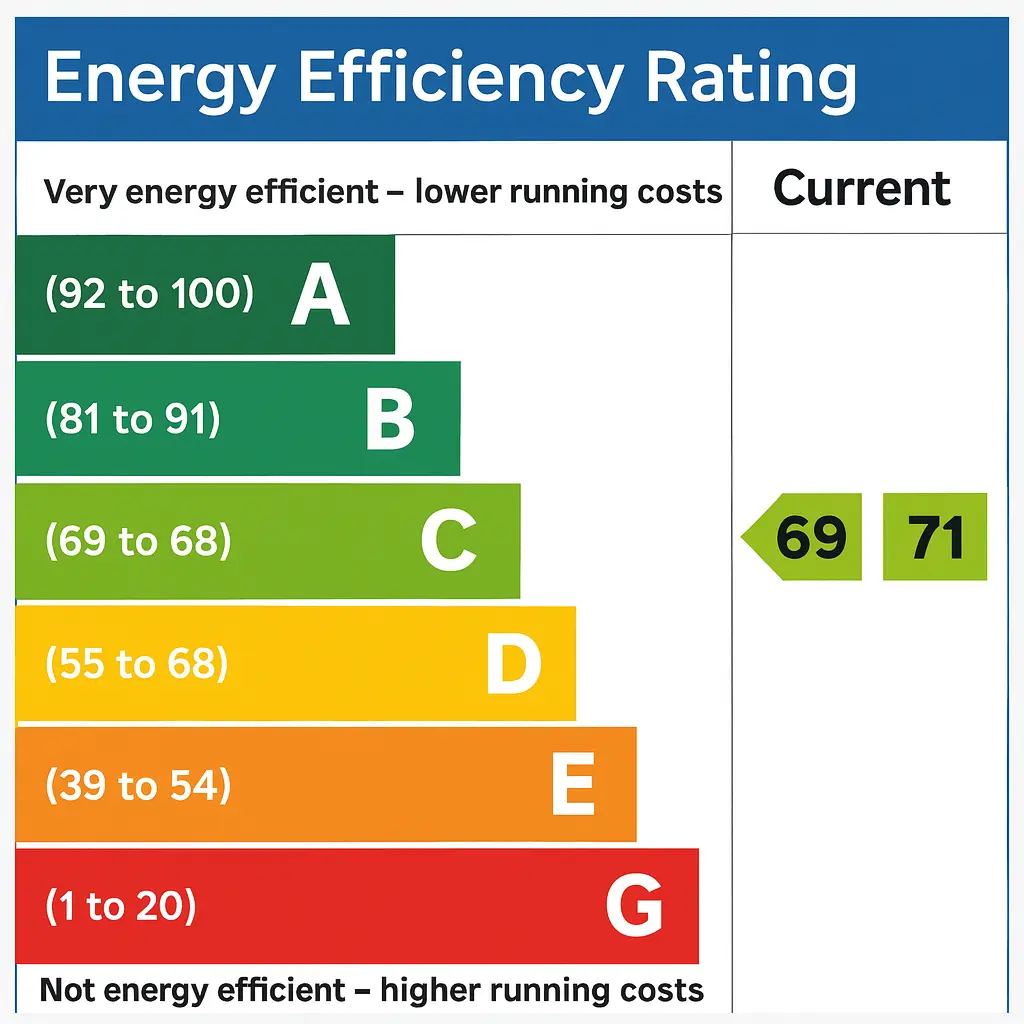
EPC rating chart: bands A to G and their scores
Every certificate gives the home a score and a band. A higher score means a more efficient home. The bands below are the ones printed on certificates from the GOV.UK register, which also says that the better the rating and score, the lower your energy bills are likely to be.
| Band | Score | What it means for running costs |
|---|---|---|
| A | 92 or more | Most efficient. Bills for heating, hot water and lighting are likely to be lowest. |
| B | 81 to 91 | Very efficient. Likely to be cheap to heat. |
| C | 69 to 80 | Good. Better than the England and Wales average of D. |
| D | 55 to 68 | Average. Likely to cost more to heat than a C. |
| E | 39 to 54 | Below average. Likely to cost more to heat than a D. |
| F | 21 to 38 | Poor. Likely to be expensive to heat. |
| G | 1 to 20 | Least efficient. Bills are likely to be highest. |
The register gives the average for homes in England and Wales as band D, with a score of 60.
EPC rating C
A score of 69 to 80. This is a good result and beats the England and Wales average. Under Ofgem's ECO4 rules, homes rated C or above generally cannot get ECO4 funding.
EPC rating D meaning
A score of 55 to 68, which is the average band. A homeowner with a D-rated home can be eligible for ECO4, but private tenants need an E or below. ECO4 work on a D-rated home has to lift it to at least a C.
EPC rating E
A score of 39 to 54. It is below average and the lowest band a private landlord can normally let at in England and Wales. ECO4 work on an E-rated home also has to lift it to at least a C.
What is an EPC rating?
An Energy Performance Certificate (EPC) tells you how energy efficient a property is (GOV.UK). The EPC rating is the letter on it. Government statistics call it the energy efficiency rating, so the two terms mean the same thing.
An accredited assessor visits the home and records the walls, roof, floor, windows, heating, hot water and lighting. Software then works out the score using RdSAP, a reduced data version of the Standard Assessment Procedure. The current version, RdSAP 10, replaced RdSAP 2012 on 15 June 2025.
The score is based on the building and its fixed services, using standard assumptions about who lives there and how they use energy (ONS). That is what lets you compare homes fairly. Two identical houses get the same rating, even if one household keeps the heating on all day.
Your certificate also has a separate environmental impact rating, again A to G, based on how much carbon dioxide the home produces each year. When people talk about their EPC rating they nearly always mean the energy rating.
EPC Rating Chart: UK Home Energy Efficiency Bands A to G
How to check your EPC rating for free
- For England, Wales and Northern Ireland, use Find an energy certificate on GOV.UK. You can search by postcode, by street name and town, or by certificate number, and download the certificate for free.
- For Scotland, use the Scottish EPC Register, run by the Energy Saving Trust with Scottish Government funding. Search by postcode or by the report reference number.
- Or use the EPC rating checker at the top of this page. Enter your postcode, pick your address and we show the certificate details held for it.
- If nothing comes up, the home has no valid certificate on the register. You can find an accredited assessor through GOV.UK's Get a new energy certificate service.
What the certificate shows
- Your current rating and score, plus the potential rating if you made the recommended improvements.
- A rating from very good to very poor for each feature, such as the walls, windows, heating and lighting.
- What an average household would spend a year on heating, hot water and lighting in the home.
- The environmental impact rating.
- Steps you could take, each with a typical cost, a typical yearly saving and the rating you could reach after it.
- The "valid until" date.
If you think your rating is wrong, the certificate tells you to complain to the assessor first, then to their accreditation scheme.
Does a better EPC rating mean lower bills?
Usually, yes. But the rating models a standard household, not yours. Your real bills depend on how many people live in the home, how warm you keep it, the fuel you use and your tariff.
The yearly cost printed on the certificate uses average energy prices from the year it was made, so an older certificate can understate or overstate today's costs. Treat it as a way to compare homes and to rank improvements, not as a bill forecast.
How long is an EPC valid?
An EPC is valid for 10 years (GOV.UK), and you can reuse it as many times as you need in that period (GOV.UK guidance). The expiry date is printed on the certificate. After it expires you only need a new one when you next sell, let or build. You can also get one sooner after improvements, so the better rating is on record.
Changes coming to EPCs
In England and Wales, the government plans new-style certificates with four headline measures: energy cost, fabric performance, heating system and smart readiness. It has moved the launch to the second half of 2027, and existing certificates keep their 10-year validity (GOV.UK).
In Scotland, new-style certificates will be valid for five years instead of 10. The Scottish Government has proposed that the new rules start in April 2028 (gov.scot).
Who needs an EPC?
You must have an EPC when you sell a property, rent one out or build a new one, and you must order it before you market the property (GOV.UK). You can be fined if you do not get one when you need it. In England and Wales the fixed penalty for a home can be £200.
- Renting out a single room in your home does not need an EPC under the England and Wales rules.
- In Scotland the EPC must be displayed in the property, for example in the meter cupboard or next to the boiler.
- If you own your home and are not selling or letting it, you do not need one. You do not need one to apply for ECO4 either, because the home is assessed before any work starts.
EPC rules for landlords
In England and Wales, landlords cannot let, or continue to let, a private rented home rated below E unless an exemption applies (GOV.UK landlord guidance). In January 2026 the government said it plans to raise the minimum to band C or equivalent for all private tenancies by 1 October 2030, subject to Parliament (GOV.UK).
How to improve your EPC rating
Start with the steps on your own certificate. The register lists them in order and says each step builds on the one before. Its own example is insulating before you buy a new boiler, because a well insulated home loses less heat and the boiler runs less.
- Insulation in the loft, walls and floor. See our guides to loft insulation grants, cavity wall insulation, external wall insulation and the wider insulation grant overview.
- Draught proofing and double glazing.
- Better heating controls, such as a smart thermostat. See smart heating controls grants.
- A more efficient boiler in place of an old one. See how the free boiler grant works under ECO4.
- A heat pump. Your certificate may point you to the Boiler Upgrade Scheme, and our air source heat pump grant guide explains the options.
- Solar panels. See our guide to solar panel grants.
- Low energy lighting in every fitting.
How far each step moves your score depends on the home, so nobody can promise a jump from D to C without looking at it. GOV.UK's Find ways to save energy in your home service gives tailored ideas for homes in England and Wales. When the work is done, book a new EPC so the higher rating is recorded.
EPC rating and ECO4 grants
ECO4 is funded by large energy suppliers under rules set by government and administered by Ofgem. It covers England, Scotland and Wales and ends on 31 December 2026. Your EPC rating is one of the checks. GOV.UK lists these bands:
- Homeowners: D, E, F or G.
- Private tenants: E, F or G.
- Social housing tenants: E, F or G might be eligible.
Ofgem's ECO4 guidance says homes rated C or above are not eligible, apart from a narrow in-fill exception. The starting rating comes from a pre-retrofit assessment of the home, not from an old certificate, and the work has to raise it. F and G homes must reach at least band D, and D and E homes at least band C. That is why ECO4 work often includes more than one measure.
The rating alone does not decide anything. You also need a qualifying route, such as a means-tested benefit or a council referral under LA Flex. In a private rented home, a boiler-only replacement is usually not possible under ECO4. Meeting the criteria does not guarantee an installation. Read how the ECO4 scheme works or browse all home energy grants.
Apply Free Boiler is run by Reliant Energy Solutions Ltd, an ECO4 installer. We do not issue EPCs, and we are not the government, Ofgem or an energy supplier.
Quick answers
Is energy rating E or F better?
E is better. The scale runs from A (best) to G (worst), so E sits one band above F. A score of 39 to 54 is an E and 21 to 38 is an F.
What is a good EPC rating?
C or above. It beats the England and Wales average of D, and it is the band the government wants private rented homes to reach by 2030.
Can I work out my own EPC rating?
Not officially. Only an accredited assessor can produce an EPC. Your existing certificate already shows your score and the score you could reach.
How much does an EPC cost?
You pay the accredited assessor directly (GOV.UK). Ask more than one for a quote before you book.