
Air-to-Air Heat Pump Grant 2026: The New £2,500 and Why Nobody Has Received It Yet
Last updated 7 October 2026. Written by the ApplyFreeBoiler Team. Every scheme rule below was checked against GOV.UK, Ofgem, MCS and the devolved governments on that date.
Disclosure
- Is there a grant for air-to-air heat pumps in the UK?
- How does the £2,500 Boiler Upgrade Scheme grant for air-to-air work?
- Why were air-to-air heat pumps left out until 2026?
- Air-to-air vs air-to-water: which one does your home need?
- Can you get an air-to-air heat pump free through ECO4 or the Warm Homes: Local Grant?
- What about Scotland, Wales and Northern Ireland?
- How much does an air-to-air heat pump cost in the UK?
- What does an air-to-air heat pump cost to run?
- Do you need planning permission for an air-to-air heat pump?
- Three example homes
- How to claim the air-to-air heat pump grant, step by step
- Which route should you take?
- Frequently asked questions
- Sources
- About this guide
Between April and August 2026, 145 households applied for the new air-to-air heat pump grant under the Boiler Upgrade Scheme. By the end of August, not one of them had been issued a voucher, and not one grant had been paid (DESNZ, Boiler Upgrade Scheme statistics, August 2026).
The grant itself is real. It has been written into law since 28 April 2026, and GOV.UK lists it in plain words. The catch sits one step further down the chain. You can only get the money through an installer certified by MCS for air-to-air heat pumps, and as of the latest MCS update, no such installer exists yet.
If you have been searching for an air to air heat pump grant, you have probably found pages telling you there isn't one, pages saying there is, and installers who can't tell you which. Most of those pages are out of date or only half right. This guide sets out where things actually stand in October 2026, scheme by scheme and nation by nation, with links to the source for every rule.
Quick answer: Yes. Since 28 April 2026, homeowners in England and Wales can get £2,500 off an air-to-air heat pump through the Boiler Upgrade Scheme. In practice nobody had received it by the end of August 2026, because MCS had not yet certified any air-to-air installers. ECO4, the Warm Homes: Local Grant and Home Energy Scotland don't fund air-to-air today.
Is there a grant for air-to-air heat pumps in the UK?
There is one grant, and it lives inside the Boiler Upgrade Scheme (BUS). Everything else either excludes air-to-air in writing or doesn't fund it at all yet. Here is the full picture as of 7 October 2026.
| Scheme | Where | Funds air-to-air? | Amount | Status in October 2026 |
|---|---|---|---|---|
| Boiler Upgrade Scheme | England and Wales | Yes, since 28 April 2026 | £2,500 | Open in law, but no MCS-certified air-to-air installers yet |
| ECO4 | England, Scotland, Wales | No (funds wet-system heat pumps only) | Often full cost for eligible households | Ends 31 December 2026 |
| Warm Homes: Local Grant | England | Not yet. Allowed once MCS can certify air-to-air | Up to £16,600 for low-carbon heating | Open, delivered by councils |
| Home Energy Scotland Grant and Loan | Scotland | No, excluded in writing | Up to £7,500 grant for other heat pumps | Open |
| Nest (Warm Homes Programme) | Wales | Not stated. Published pages say “heat pump” only | Varies | Open |
| Boiler Replacement Scheme / future heat scheme | Northern Ireland | No scheme yet | None | Boiler Replacement Scheme closed. New scheme being designed |
| 0% VAT on installation | Great Britain and NI | Yes, if the unit is permanently fixed | Saves 20% VAT | Until 31 March 2027 |
Two things jump out of that table. First, the only cash grant is the £2,500 under BUS, and it only works in England and Wales. Second, the 0% VAT relief, which almost nobody mentions, already applies to air-to-air units today. HMRC's own guidance says “most air conditioning units are air source heat pumps” (HMRC VAT Notice 708/6). If you pay for a fixed system yourself before 1 April 2027, the installation should be zero-rated, though HMRC says borderline cases depend on the facts.
How does the £2,500 Boiler Upgrade Scheme grant for air-to-air work?
Quick answer: The installer applies to Ofgem for a BUS voucher and takes £2,500 off your quote. You need to own the home, it must be residential, and the heat pump has to replace your existing fossil fuel or electric heating. The installer must be MCS certified for air-to-air heat pumps.
How the grant came about
The air-to-air grant has a short and well-documented history. The Department for Energy Security and Net Zero (DESNZ) consulted on adding air-to-air heat pumps to BUS between 30 April and 11 June 2025, suggesting a grant of £1,000 to £2,000 (DESNZ consultation, 2025). The government response in November 2025 went higher, “creating a new grant category for AAHPs with specific eligibility criteria, guidance, and a grant value of £2,500” (government response, November 2025).
The Warm Homes Plan, published on 21 January 2026, then confirmed “new £2,500 grants towards the cost of installing air-to-air heat pumps and heat batteries for central heating” (Warm Homes Plan). The legal change followed in The Boiler Upgrade Scheme (England and Wales) (Amendment) Regulations 2026, made on 19 March and in force from 28 April 2026.
The rules, in plain English
Pulling together GOV.UK's eligibility page and Ofgem's guidance for property owners (version updated 2 July 2026):
- You must own the property. If you rent, your landlord would need to apply.
- The building must be residential. Ofgem limits air-to-air grants to residential buildings, so shops and offices can't use this category.
- You must be replacing your current heating. GOV.UK lists the systems you can replace as heating “such as oil, gas, electric or LPG”. So electric panel heaters and storage heaters count, as well as gas and oil boilers.
- No hybrids. You can't keep a gas boiler running alongside and still claim.
- Backup heating is allowed if it isn't fossil fuel. Ofgem's installer guidance allows supplementary heating alongside a BUS heat pump, as long as it isn't fossil fuelled (Ofgem installer guidance). An electric towel rail or a portable heater for a cold box room is fine.
- You no longer need an EPC. The old requirement for a valid Energy Performance Certificate with no outstanding loft or cavity insulation recommendations has gone.
- One grant per property. You can't claim £2,500 for an air-to-air system and then £7,500 for an air-to-water one later.
- The grant comes off the bill. You never apply yourself. Your installer applies for the voucher and the grant comes off your quote upfront.
Why nobody has got the money yet
Here's the bottleneck. Every BUS grant has to go through an installer certified by MCS (the Microgeneration Certification Scheme) for that technology. MCS had to write a new installer standard for air-to-air heat pumps, get it approved, and then get the certification bodies accredited to assess installers against it.
As of its consumer page updated on 24 July 2026, MCS said: “At the moment, no installers are yet certified to install air-to-air heat pumps” (MCS, air-to-air heat pumps). MCS has explained that UKAS approved the updated scheme, but certification bodies still needed their own accreditation before they could certify anyone (MCS implementation update). Trade reporting in mid-September 2026 still showed no certified air-to-air installers.
The result shows up in the official statistics. DESNZ recorded 145 air-to-air applications between April and August 2026, with zero vouchers issued and zero redemptions (DESNZ, August 2026). For comparison, the scheme as a whole had received 151,136 applications and paid £661.3 million in grants by 31 August 2026 (Ofgem BUS monthly update).
Until an installer can show you an issued voucher, treat the £2,500 as maybe, not definitely, and don't pay a deposit on the promise of it.
Why were air-to-air heat pumps left out until 2026?
Quick answer: BUS was built around heat pumps that feed radiators and hot water through a wet central heating system. Most air-to-air units heat rooms only and can't make hot water, and the government didn't want to subsidise what is, in many cases, an air conditioner.
When DESNZ opened the 2025 consultation, it described hydronic (air-to-water) heat pumps as “the key strategic technology” the scheme was built to support (DESNZ consultation document, April 2025). The same document notes that around 89% of UK homes already have hydronic (wet) heating, so a heat pump that plugs into existing radiators reaches far more homes.
The rules also required a BUS heat pump to deliver space heating and hot water using liquid. An air-to-air unit moves heat through the air instead, and most of them can't heat water at all. On top of that, air-to-air units sold in the UK mostly go into offices and shops: the consultation estimated that around 95% of air-to-air heat pumps currently sold in the UK go to non-domestic buildings. The government was wary of paying for summer air conditioning.
What changed was the type of home in view. Many flats and smaller homes run on direct electric heating with no wet system at all. For them an air-to-water heat pump means fitting radiators, pipework and a hot water cylinder from scratch. An air-to-air system can go on the wall in a day or two, and the Warm Homes Plan describes it as “cheaper to install than a hydronic heat pump”. That's why the new grant exists and why it's smaller than the £7,500 for air-to-water.
Air-to-air vs air-to-water: which one does your home need?
Quick answer: Air-to-air heats rooms directly through wall or ceiling units and can cool in summer, but it doesn't heat water. Air-to-water feeds radiators or underfloor heating and a hot water cylinder. If you already have radiators, air-to-water usually fits better. If you have electric heaters and no wet system, air-to-air is often the cheaper switch.
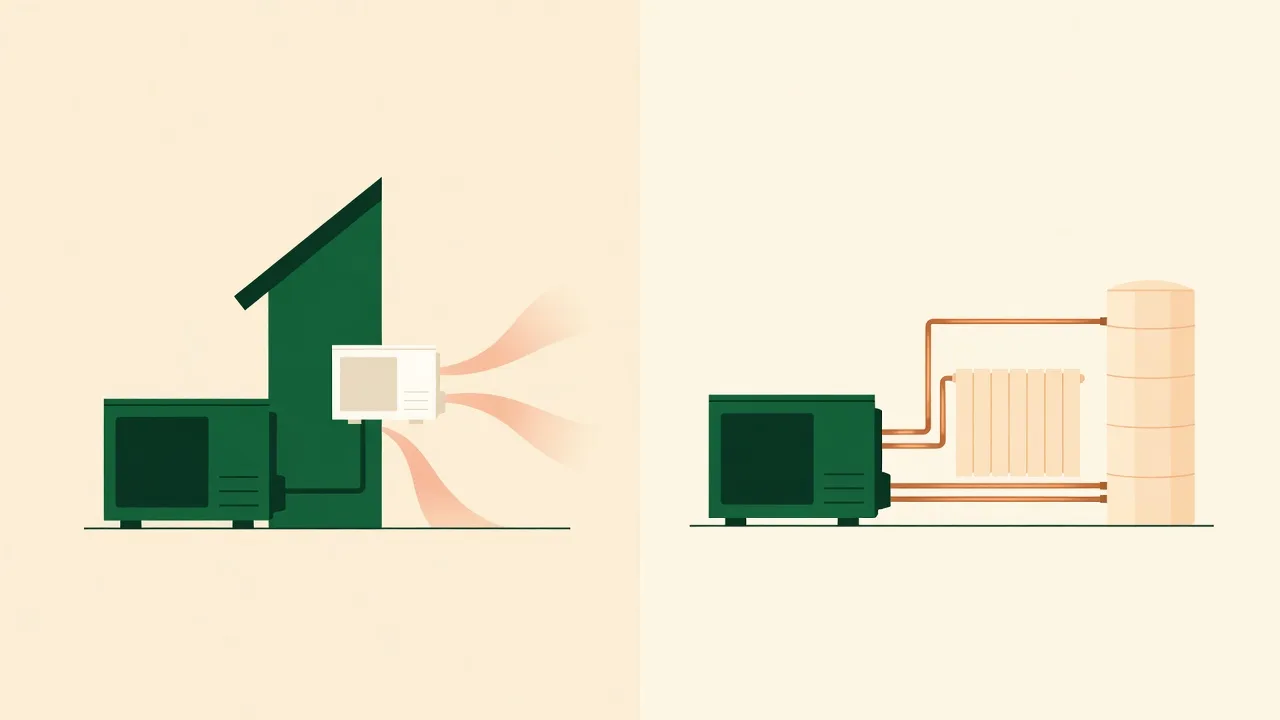
Both types pull heat out of the outside air with an outdoor unit. The difference is what happens indoors.
An air-to-air heat pump (often called a split or multi-split system) pumps refrigerant to one or more indoor units mounted on walls or ceilings. Those units blow warm air into the room. Run the cycle backwards and they cool the room instead, which is why they look and behave like air conditioning. HMRC treats them the same way for VAT.
An air-to-water heat pump heats water and sends it round your radiators or underfloor heating, and usually heats a hot water cylinder too. It replaces a boiler almost like for like, though radiators sometimes need upsizing.
| Air-to-air | Air-to-water | |
|---|---|---|
| How heat reaches you | Warm air from indoor wall or ceiling units | Hot water through radiators or underfloor heating |
| Hot water | No. You need an immersion heater or a separate system | Yes, through a cylinder |
| Cooling in summer | Yes, most units | Not usually |
| Typical installed cost | About £3,900 for a 2 to 3 bed flat (DESNZ estimate) | Median £12,908 (BUS installs, Q2 2026) |
| BUS grant | £2,500 | £7,500, or £9,000 off-gas replacing oil or LPG |
| Best fit | Flats and small homes with electric heating and no wet system | Homes with radiators, or anyone who also needs hot water |
| Funded by ECO4? | No | Yes, for eligible households |
The efficiency comparison is harder than sales brochures suggest. DESNZ modelling published in July 2026 found air-to-water heat pumps typically achieved between 3:1 and 3.5:1, while air-to-air systems with supplementary heaters ranged from around 2.5:1 to around 4:1 (DESNZ, suitability of reversible air-to-air heat pumps, July 2026). An earlier DESNZ literature review warned that the two numbers aren't directly comparable, because the air-to-water figure includes heating hot water, which is harder work (DESNZ literature review, March 2025).
A common pitfall: choosing air-to-air for a three or four bedroom house with an existing gas boiler and radiators, purely because the upfront price looks lower. By the time you have an indoor unit in every room, the price gap shrinks, you lose the bigger £7,500 grant, and you still need a way to heat water. Our air source heat pump grant guide covers the air-to-water route in detail.
Can you get an air-to-air heat pump free through ECO4 or the Warm Homes: Local Grant?
Quick answer: Not today. ECO4 funds heat pumps that feed a wet central heating system, so air-to-air doesn't fit. The Warm Homes: Local Grant says air-to-air is ineligible until MCS can certify it, then it can be funded. ECO4 also closes on 31 December 2026.
ECO4
ECO4 is the energy company scheme that pays for heating and insulation in low-income homes, and it's the scheme we install under. Its delivery guidance defines the heat pump measure it funds as hydronic, one that “delivers heat in the form of fluid in a wet central heating system” (Ofgem ECO4 Delivery Guidance v4.0, March 2026). Our reading is that an air-to-air unit isn't an installable ECO4 measure. We haven't found a sentence that bans it outright, but we haven't found any route that funds it either.
What ECO4 can do is pay for an air-to-water heat pump, plus radiators and insulation, for eligible households. If you're on means-tested benefits or have a low household income and your home has a poor EPC rating, that can work out far cheaper for you than a part-funded air-to-air system. Check whether you qualify with our free eligibility checker.
ECO4 has a hard end date of 31 December 2026, set out in Ofgem's guidance above and the extension in SI 2026/361. We cover what that means for applications in ECO4 ends 31 December 2026: what the deadline means.
Warm Homes: Local Grant (England)
The Warm Homes: Local Grant is a council-run scheme in England. It pays for insulation, solar and low-carbon heating in low-income homes rated EPC D to G. Its policy guidance says “air-to-air heat pumps are not eligible for the Warm Homes: Local Grant, until they are able to be certified by MCS” and expects that to happen in 2026 (GOV.UK, Warm Homes: Local Grant).
That matters because the Local Grant is generous. It can fund up to £16,600 per home for energy upgrades and up to £16,600 for low-carbon heating. You may qualify if your household income is £36,000 a year or less, you live in a qualifying postcode, or someone in the household gets certain means-tested benefits (apply for the Warm Homes: Local Grant). Once MCS starts certifying air-to-air installers, this could become the route to a fully funded air-to-air system for eligible flats with electric heating. Until then, the council will offer other measures.
What about Scotland, Wales and Northern Ireland?
Quick answer: Wales gets the same £2,500 BUS grant as England. Scotland's Home Energy Scotland scheme excludes air-to-air in writing. Northern Ireland has no heat pump grant at all yet, though one is being designed.
Scotland
BUS doesn't apply in Scotland. Instead, Home Energy Scotland Grant and Loan offers up to £7,500 as a grant for a heat pump, a £1,500 rural uplift for eligible homes, and an optional interest-free loan of up to £7,500. But the scheme is clear on air-to-air: “Hybrid heat pumps, air-to-air heat pumps and exhaust air heat pumps are not eligible for funding.”
So in Scotland, the realistic routes are an air-to-water heat pump through Home Energy Scotland, ECO4 before it closes, or paying for an air-to-air system yourself with 0% VAT. Warmer Homes Scotland offers “support worth £10,000 or more” to qualifying households, but its pages don't say whether it fits air-to-air, so ask the advisers directly. Our Scotland grants page covers the wider options.
Wales
The Boiler Upgrade Scheme regulations cover England and Wales, so the £2,500 air-to-air grant applies in Wales on exactly the same terms. Welsh homes had received 4,938 BUS redemptions by August 2026, about 5% of the total (DESNZ statistics above).
Wales also runs Nest, the Warm Homes Programme, for lower-income households. Nest lists “boiler repair or replacement, heat pump, insulation and solar panels” among its measures. It doesn't say which type of heat pump, so if air-to-air matters to you, ask Nest before your survey.
Planning is a little easier in Wales from this year. Since 1 June 2026, air-to-air heat pumps also benefit from permitted development rights in Wales (MCS, Wales PDR changes).
Northern Ireland
Northern Ireland has no Boiler Upgrade Scheme, and GOV.UK notes that “the Boiler Replacement Scheme in Northern Ireland is now closed”. The Department for the Economy published its response to a low carbon heating support consultation in January 2026. Its plan is to consult on a support scheme this year and legislate next year, before any launch (Department for the Economy, January 2026). Realistically, a heat pump grant in NI is at least a year away.
The Affordable Warmth Scheme run by the Housing Executive helps households with income under £23,000, with grants up to £7,500 (or £10,000 where solid wall insulation is needed). Heat pumps aren't among its listed measures. More on Northern Ireland grants here.
How much does an air-to-air heat pump cost in the UK?
Quick answer: A single-room split unit typically costs £1,500 to £3,500 fitted. DESNZ estimated about £3,900 to heat a 2 to 3 bed flat. Whole-house multi-split systems with four or more indoor units can run from £5,000 to over £12,000. The £2,500 BUS grant and 0% VAT both come off.
There's no official dataset for air-to-air installation prices yet, because no BUS air-to-air jobs have been completed. These are the best figures available, with the source for each.
| System | Typical installed cost | Source |
|---|---|---|
| Single-room split (1 indoor unit) | £1,500 to £3,500 | Trade2Base, June 2026 |
| 2 to 3 bed flat, whole home | About £3,900 including hardware and labour | DESNZ consultation, April 2025 |
| Multi-split, 2 indoor units | £3,000 to £6,000 | Trade2Base, June 2026 |
| Typical air-to-air job | £5,000 to £8,000, about £1,500 to £2,300 per indoor unit | City Plumbing, July 2026 |
| Multi-split, 4 or more indoor units | £5,000 to £12,000+ | Trade2Base, June 2026 |
| Air-to-water heat pump (for comparison) | Median £12,908 (middle half £11,128 to £15,627) including grant value | DESNZ BUS statistics, Q2 2026 |
| Air-to-water, MCS average | Around £13,300 in 2025 | MCS |
What you'd actually pay after the grant
Taking the DESNZ flat estimate of £3,900 and subtracting the £2,500 grant leaves around £1,400. For a typical air-to-water install at the BUS median of £12,908, the £7,500 grant leaves around £5,400. For a flat with electric heating, that difference is the whole case for the new grant.
Two things push the real price up:
- Number of rooms. Each indoor unit adds cost. A one-bed flat might need two units; a three-bed house could need four or five.
- Pipe runs and the outdoor unit position. Long refrigerant runs, awkward wall drilling or a unit mounted high up all add labour.
Don't forget hot water. Because air-to-air doesn't heat water, you'll keep an immersion heater or need a separate system. A heat pump hot water cylinder is one option, but it's a separate cost and not covered by the air-to-air grant.
The VAT saving
Installing energy-saving materials, including air source heat pumps, is zero-rated for VAT “from 1 May 2023 to 31 March 2027” (HMRC Notice 708/6). HMRC's view is that most air conditioning units are air source heat pumps, but only permanently fixed units qualify, so a portable air conditioner doesn't. On a £5,000 job, that's £1,000 of VAT you don't pay. The relief is due to end on 31 March 2027, after which the rate goes to 5%, unless the government extends it.
What does an air-to-air heat pump cost to run?
Quick answer: At the October to December 2026 price cap (electricity 26.32p/kWh, gas 7.97p/kWh), an air-to-air heat pump with a real-world efficiency of about 3 costs roughly the same to run as a modern gas boiler, and about a third of what direct electric heaters cost.

Running cost comes down to one sum: the heat your home needs, divided by how efficiently the system makes it, multiplied by the price per unit. The table below uses Ofgem's cap for 1 October to 31 December 2026 (Ofgem price cap unit rates): electricity 26.32p/kWh and gas 7.97p/kWh.
Illustrative example: a home that needs 8,000 kWh of space heating a year. This is a worked example to show the method, not a quote for your home. Standing charges and hot water are left out.
| Heating system | Efficiency used | Energy bought | Yearly heating cost |
|---|---|---|---|
| Direct electric panel heaters | 1.0 (100%) | 8,000 kWh electricity | £2,106 |
| Air-to-air, poor install | 2.5 | 3,200 kWh electricity | £842 |
| Gas boiler | 0.9 (90%, our assumption) | 8,889 kWh gas | £708 |
| Air-to-air, typical real world | 3.0 | 2,667 kWh electricity | £702 |
| Air-to-air, good install | 4.0 | 2,000 kWh electricity | £526 |
The efficiency range comes from DESNZ, which modelled air-to-air systems at around 2.5:1 to around 4:1. The DESNZ literature review put a realistic real-world figure at about 2.8, against a declared minimum around 3.4, and found field results in Sweden spread anywhere from 2.0 to 5.0. Swedish homes have used air-to-air heat pumps for years, which is why so much of the evidence comes from there.
Three things follow from the numbers:
- Against electric heaters, air-to-air wins easily. Cutting a £2,106 heating bill to around £700 is the main reason the government added the grant.
- Against gas, it's roughly level. You won't save much on heating alone, though if you remove gas completely you also stop paying the gas standing charge of 29.68p a day, about £108 a year.
- Installation quality decides the result. The gap between £526 and £842 a year is entirely down to sizing, unit placement and how you use it. That's one reason the grant insists on MCS-certified installers.
If you want to model your own home, our heat pump running cost calculator lets you plug in your own numbers.
Do you need planning permission for an air-to-air heat pump?
Quick answer: In England, usually not. Since 29 May 2025, permitted development rights cover air-to-air heat pumps as long as they aren't used solely for cooling and fit the size and number limits. Wales extended the same rights to air-to-air from 1 June 2026. In Scotland, check with your council.
For years, air-to-air units fell outside the permitted development rules for heat pumps in England, which meant a planning application for something many neighbours already had on their walls. That changed with The Town and Country Planning (General Permitted Development etc.) (England) (Amendment) Order 2025, in force from 29 May 2025. It added the condition that “the air source heat pump is not solely used for the purpose of cooling”, which brought air-to-air units in.
Key limits in England include:
- One heat pump on a non-detached house or block of flats, two on a detached house.
- The outdoor unit must be no bigger than 1.5 cubic metres on a house, or 0.6 cubic metres on a block of flats.
- No units on pitched roofs.
- The old rule requiring units to sit at least 1 metre from the boundary has been removed.
- Listed buildings and conservation areas still have extra restrictions.
If you live in a flat, you'll usually also need the freeholder's permission to fix anything to an external wall, whatever the planning position. Check your lease before you book a survey.
Three example homes
These are illustrative scenarios built from the rules above, not real customers. Names and numbers are made up to show how the choice plays out.
1. A one-bed flat in Leeds with old storage heaters. Priya owns a one-bed flat heated by two storage heaters and a panel heater in the bathroom. There's no gas and no wet system. An air-to-water heat pump would mean new radiators, pipework and a cylinder in a flat with no space for one. An air-to-air system with two indoor units fits the home well. At a quoted £4,200, the £2,500 BUS grant would bring it to £1,700, and her heating bill could fall by more than half. Her problem is timing: she needs an installer with MCS air-to-air certification, and none exist yet. Her best move is to get quotes lined up now and book the job once an installer can issue a voucher. If her income is under £36,000, she should also ask her council about the Warm Homes: Local Grant, which could fund the whole thing once air-to-air becomes eligible.
2. A three-bed semi in Stoke with a gas boiler, on Universal Credit. Dave's boiler is 18 years old and his house has radiators in every room. An air-to-air system would need four or five indoor units, would only get the £2,500 grant, and wouldn't heat his water. Because he's on Universal Credit and his house is rated EPC D, he may qualify for ECO4, which can fund an air-to-water heat pump or a new boiler plus insulation at no cost to him. ECO4 closes on 31 December 2026, so the window is short. For Dave, air-to-air is the wrong answer.
3. An oil-heated cottage in rural Wales. Gwen heats a detached cottage with an ageing oil boiler. Under BUS she could get £2,500 for air-to-air, or £9,000 for an air-to-water heat pump replacing oil, through the off-gas uplift that runs from 21 July 2026 to 31 March 2027 (Ofgem guidance). Her radiators can stay, and her hot water is covered. The bigger grant and the working wet system make air-to-water the clear choice, and the uplift deadline means she shouldn't wait.
How to claim the air-to-air heat pump grant, step by step
Once MCS-certified air-to-air installers start appearing, this is the process. You don't apply to Ofgem yourself. Your installer does it.
- Confirm you're eligible. You own the home, it's residential, it's in England or Wales, and the air-to-air system will replace your current heating rather than sit alongside a gas or oil boiler. Checkpoint: you can answer yes to all four.
- Find MCS-certified installers. Use the MCS installer search and filter for air-to-air heat pumps. Ask at least three for a survey. Checkpoint: each installer can name their air-to-air MCS certification.
- Get a heat loss survey and written quotes. A proper survey works out how much heat each room needs. A quote based on a quick look at the room isn't enough. Checkpoint: the quote lists every indoor unit, the outdoor unit, and the £2,500 as a BUS discount.
- Check VAT is zero-rated. Before 1 April 2027, the installation of a fixed unit should carry 0% VAT. Checkpoint: the quote shows VAT at 0%.
- Let the installer apply for the voucher. Ofgem contacts you to confirm you agreed to the application. Reply promptly, or the voucher can be held up. Checkpoint: you've received and answered Ofgem's confirmation email.
- Book the installation once the voucher is issued. Don't let work start before then. Checkpoint: you have the voucher number in writing.
- Sign off and keep the paperwork. You should get an MCS certificate for the installation. Keep it with your property documents, because buyers and lenders increasingly ask for it.
What to do in the next 48 hours
- Note down your current heating, the number of rooms you'd want heated, and your last 12 months of electricity and gas use from your bills.
- Check the MCS installer search for air-to-air certified installers near you.
- If you're on benefits or a low income, check ECO4 and Warm Homes: Local Grant eligibility now with our eligibility checker, because one of them may pay for more than the £2,500 does.
Which route should you take?
Work down this list and stop at the first one that fits you.
- You're on means-tested benefits or a low income, and your home is rated EPC D to G: check ECO4 first, before it closes on 31 December 2026, then the Warm Homes: Local Grant in England. Either could fund far more than £2,500. Check eligibility.
- You have radiators and a gas, oil or LPG boiler: an air-to-water heat pump with the £7,500 BUS grant (or £9,000 if you're replacing oil or LPG before 31 March 2027) usually beats air-to-air. See our air source heat pump grant guide.
- You have electric heating, no wet system, and you own a flat or small home in England or Wales: air-to-air with the £2,500 BUS grant is likely your best fit. Line up quotes now and wait for MCS-certified installers.
- You're in Scotland: look at Home Energy Scotland's grant and loan for air-to-water, or self-fund air-to-air with 0% VAT.
- You're in Northern Ireland: there's no heat pump grant yet. The Affordable Warmth Scheme helps with insulation and conventional heating if your income is under £23,000.
Frequently asked questions
Basics
Applying
Problems
Sources
UK government and regulators
- The Boiler Upgrade Scheme (England and Wales) (Amendment) Regulations 2026, SI 2026/390, legislation.gov.uk
- Apply for the Boiler Upgrade Scheme: what you can get, GOV.UK
- Apply for the Boiler Upgrade Scheme: check if you're eligible, GOV.UK
- Boiler Upgrade Scheme and certification requirements for clean heat schemes, consultation and outcome, DESNZ, 2025
- Amendments to the Boiler Upgrade Scheme: government response, DESNZ, November 2025
- Boiler Upgrade Scheme consultation document, DESNZ, April 2025
- Warm Homes Plan, GOV.UK, January 2026
- Boiler Upgrade Scheme statistics: August 2026, DESNZ, September 2026
- Boiler Upgrade Scheme guidance for property owners, Ofgem, July 2026
- Boiler Upgrade Scheme guidance for installers, Ofgem
- BUS monthly scheme update, Ofgem
- ECO4 Delivery Guidance, Ofgem, March 2026
- ECO4 extension, SI 2026/361, legislation.gov.uk
- Warm Homes: Local Grant policy guidance, GOV.UK
- Apply for the Warm Homes: Local Grant, GOV.UK
- Energy price cap unit rates and standing charges, Ofgem
- VAT on energy-saving materials and heating equipment (Notice 708/6), HMRC
- Town and Country Planning (General Permitted Development etc.) (England) (Amendment) Order 2025, SI 2025/560, legislation.gov.uk
Research reports
- Understanding the suitability of reversible air-to-air heat pumps for domestic use in the UK, DESNZ, July 2026
- Air-to-air heat pumps: literature review, DESNZ, March 2025
Devolved governments
- Home Energy Scotland Grant and Loan, Home Energy Scotland
- Warmer Homes Scotland, Home Energy Scotland
- Nest Warm Homes Programme, Welsh Government
- Minister publishes response to consultation on low carbon heating support, Department for the Economy NI, January 2026
- Affordable Warmth Scheme, NI Housing Executive
Industry bodies and trade sources
- Air-to-air heat pumps (consumer guide), MCS, July 2026
- Getting ready for air-to-air: an update on implementation into MCS, MCS
- Changes to permitted development rights in Wales from 1 June 2026, MCS
- Air source heat pumps (consumer guide), MCS
- HVAC installation costs UK, Trade2Base, June 2026
- Air-to-air heat pumps: the UK installer's guide, City Plumbing, July 2026
About this guide
Who wrote it: the ApplyFreeBoiler Team. ApplyFreeBoiler.uk is run by Reliant Energy Solutions Ltd, an ECO4 heating and insulation installer. Our team works on grant-funded heating and insulation jobs every week, which is why we follow scheme rule changes closely.
How we checked it: every scheme rule, grant amount and date in this guide was checked against the primary source (legislation.gov.uk, GOV.UK, Ofgem, MCS, Home Energy Scotland, the Welsh Government and the NI Department for the Economy) on 7 October 2026. Installation cost ranges come from trade sources because no official air-to-air cost data exists yet; they're labelled as such. The running cost table is a worked example using Ofgem's October to December 2026 price cap and the DESNZ efficiency range, and the 90% gas boiler efficiency is our assumption.
What we're not: we're not a government body, and we don't install air-to-air heat pumps under BUS. Grant decisions are made by Ofgem, your council or the relevant devolved scheme.
Updates: this page will be reviewed when MCS certifies the first air-to-air installers, when the price cap changes on 1 January 2027, and before the VAT relief deadline of 31 March 2027.
Changelog: 7 October 2026, first published.